

A tradition of craftsmanship in Upper Bavaria
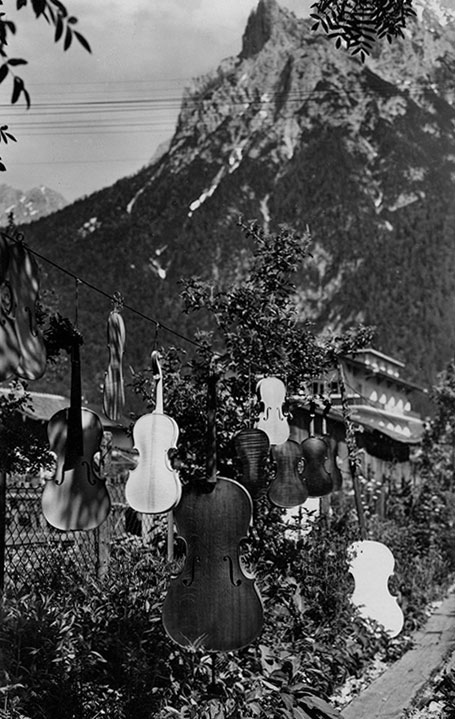
Violin and lute making were already well established in Mittenwald in the 17th century. Mittenwald violins were very popular north of the Alps in the 18th century. Leopold Mozart wrote in 1764 ‘...that Paris and London were full of Mittenwald violins.’
Mathias Klotz (1653–1743), who founded a workshop in Mittenwald around 1685/86, is considered the founding father of Mittenwald violin making. He had learned the trade from a lute maker in Füssen and, after his years of travelling in Padua, trained his three sons and others at home in Mittenwald. The Klotz family’s instruments were strongly modelled after those of Jacobus Stainer and Nicolo Amati.
In addition to the Klotz family, other violin makers established themselves as early as the 18th century, including Matthias Hornsteiner.
In addition to the craftsmen’s businesses, merchants settled in the 19th century who developed contracting businesses. Contractors supplied firms with raw materials and often only had parts made, the composition of which was in turn commissioned to other firms. Contractors thus controlled the production process. Unlike Markneukirchen, which was industrialised in the 19th century through contracting, production in Mittenwald remained in smaller manufacturing businesses.
By the end of the 18th century, there were already about 80 violin makers working in Mittenwald. In 1858, at the behest of King Maximilian II of Bavaria, the Mittenwald Geigenbauschule (Mittenwald Violin Making School) was founded to ensure systematic instruction in violin making. This long tradition of violin making continues successfully in Mittenwald in the 21st century.