

From market town to industrial center
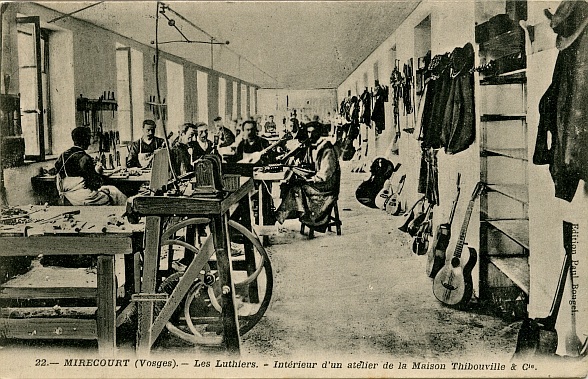
Many renowned French violin makers originated from the small town of Mirecourt in the Vosges Mountains. As early as 1732, violin makers in Mirecourt enacted strict guild rules to maintain quality standards for their instruments.
Quite a few, such as Vuillaume, Chanot, Aldric or Bernardel, left the small market town in the Vosges to settle in larger cities, Paris in particular. But some remained loyal to their homeland and established the industrial production of stringed instruments as early as 1800.
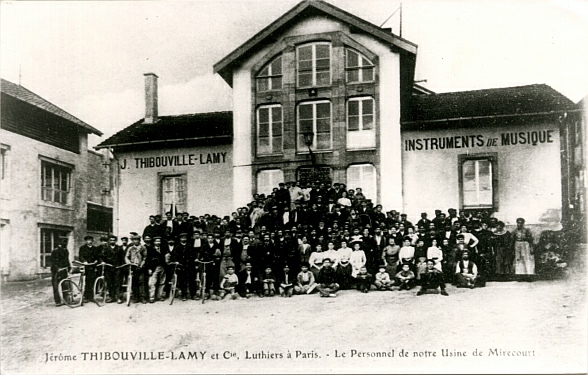
Jerome Thibouville, the Laberte brothers and later the Cuesnon brothers founded violin making companies in the mid-19th century. Until the 1960s, they were among the largest violin manufacturers in the world. During its heyday (around 1930), the Thibouville-Lamy company produced about 150,000 violins a year and employed about 1,000 violin makers.
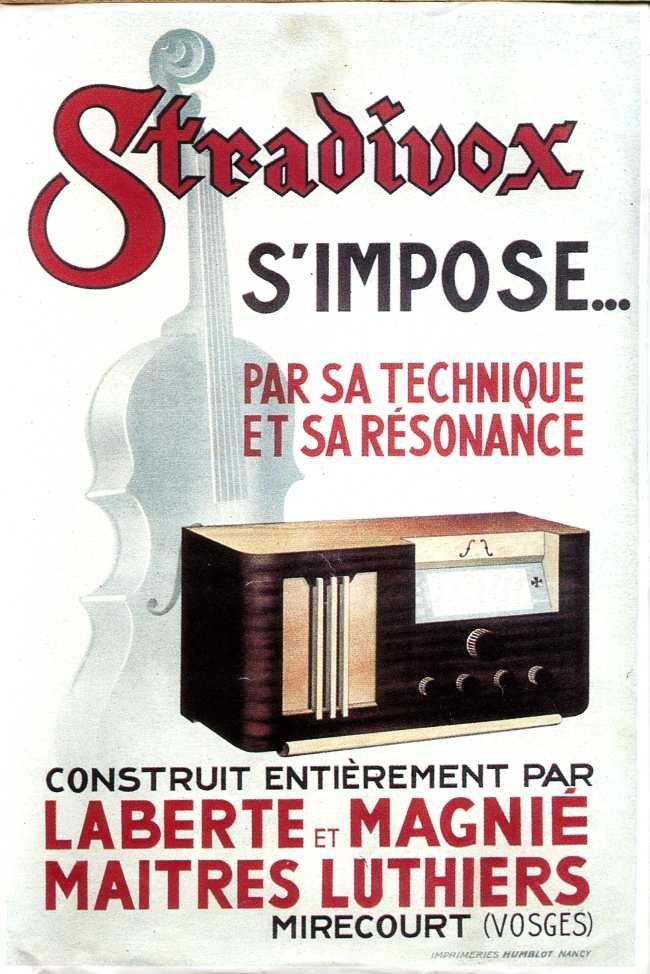
In the 1930s, the violin maker Laberte & Magnié expanded its range
of products to include gramophones and radio receivers, which were marketed under the name ‘Stradivox’.
Business connections with the great Parisian ateliers, as well as growing international exports as far as South America, provided instrument-making in the region with a unique economic upswing, which only came to a standstill with the Depression of 1930.
The instrument manufacturers were unable to recover from the economic slump caused by World War II. Between 1967 and 1969, the three most important firms declared bankruptcy within just two years. In the following years, only a few instrument makers remained in the village.
It was not until 1975 that the tradition of violin making was resumed with the founding of the violin making school in Mirecourt.
Images: www.corillon.com