

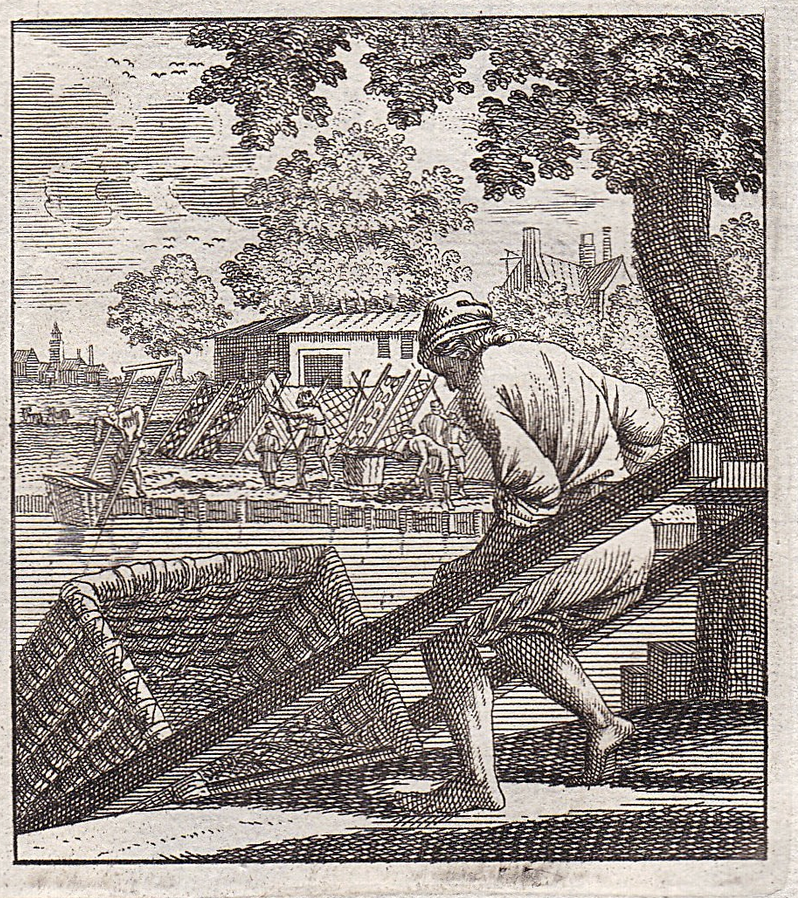
“De Lymmaker,” engraving by Jan Luyken, Amsterdam, 1720
Birch pitch and natural asphalt are considered the earliest known adhesives.
Cave paintings suggest that as early as the 7th millennium BC, the binding properties of blood and casein were already known. Excavations in Egypt and Mesopotamia show that animal glues were in use long before the Common Era.
Both in ancient Greece and in the Roman Empire, the different properties of glues made from animal bones, hides, and fish by-products were already well understood. Woodwork from around 1500 BC has survived to this day with joints that remain firmly bonded.
Up to the 16th century, glue-making methods were gradually refined, though the process itself did not fundamentally change. The demands of new technological developments, such as book printing and veneering techniques, influenced glue production.
It was only with the introduction of synthetic white glues based on petroleum at the beginning of the 20th century that traditional animal glues were gradually displaced.
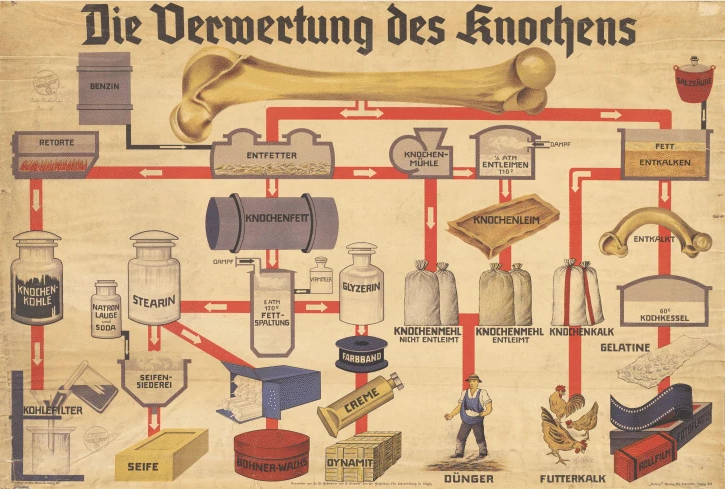
Teaching chart on the utilization of bones, 1937, Research Center for Historical Visual Media, University of Würzburg